
continuation vs reversal: how to know which edgeful reports to use
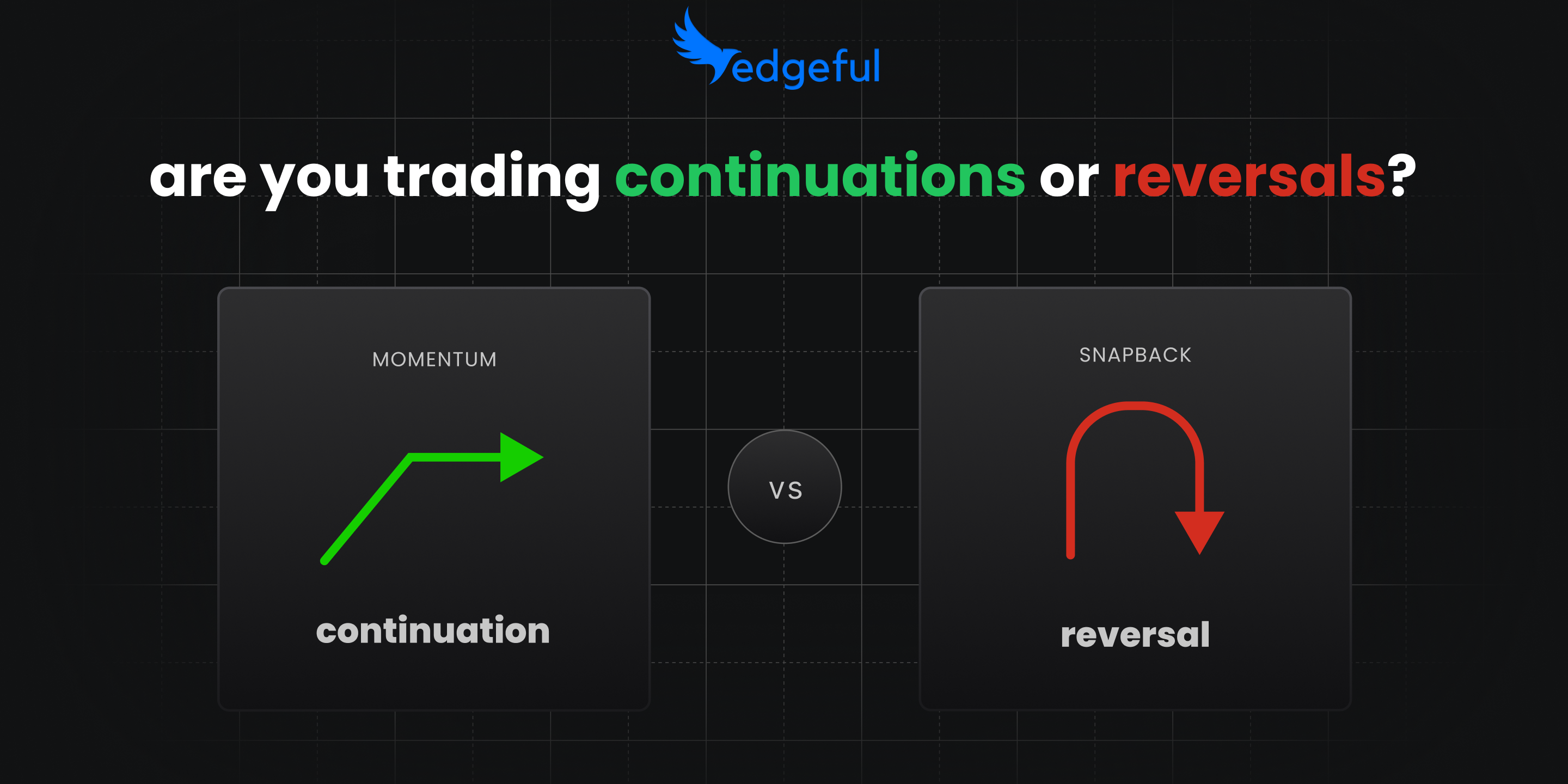
every single trade you take is either a reversal or a continuation. that's it. there's no third option.
you're either betting that price will keep going in the same direction... or you're betting it's going to turn around.
the problem? most traders don't consciously decide which one they're trading before they enter. they just "see a setup" and click buy or sell — then wonder why they keep getting stopped out or taking profits too early.
understanding the difference between continuation vs reversal setups is one of the most important concepts in data-driven trading. today I'm going to break down exactly which edgeful reports fall into each category — so you always know what you're trading and what to expect from the move.
table of contents
- what are continuation vs reversal setups?
- continuation reports: when to expect price to keep going
- opening candle continuation (OCC)
- green/red streaks
- ORB/IB (NY session)
- engulfing candles
- reversal reports: when to expect price to turn around
- the ultimate reversal setup
- weekly opening retracement
- the IB twist: same report, opposite behavior
- how to decide: continuation vs reversal
- frequently asked questions
what are continuation vs reversal setups?
before diving into specific reports, let's clarify what we mean by continuation vs reversal:
- continuation setups are trades where you expect price to keep moving in its current direction. you're riding momentum — whether that's an intraday trend, a breakout, or the extension of a larger move.
- reversal setups are trades where you expect price to turn around and move in the opposite direction. you're betting that price has extended too far and is likely to snap back toward a key level.
the key to consistent trading is knowing which type of setup you're in BEFORE you enter — and using the right data to confirm your bias.
continuation reports: when to expect price to keep going
these are the reports you use when you want to ride momentum — when the data says price is likely to continue in the current direction rather than reverse.
1. opening candle continuation (OCC)
this is one of my favorite continuation trading patterns for establishing an early bias.
the OCC report looks at the first hour of trading (9:30AM - 10:30AM ET for NY session) and measures how often the color of that candle matches the color of the entire session.
so if the first hour closes green — how often does the day also close green?
here's what the data says on YM over the last 6 months:
- green first hour → green session close 72% of the time
- red first hour → red session close 68% of the time
this gives you a clear directional bias within the first 60 minutes of the session. if the first hour is green, the data says lean bullish. if it's red, lean bearish.
simple, but incredibly powerful when you actually follow it. this is continuation vs reversal decision-making at its most basic — the first hour sets the tone, and the data says to trade with it, not against it.
→ check the OCC report for your favorite ticker
2. green/red streaks
this report tracks momentum patterns — specifically, how long do trends typically last before reversing? this report works for both scalpers/day traders and swing traders because it gives great information for trends overall.
on YM over the last 6 months:
- average green streak length: 2.12 days
- average red streak length: 1.79 days
- max green streak: 8 days
- max red streak: 5 days
you can use this data to inform your continuation vs reversal decisions. if you know you've had 2 green days in a row, it's likely the 3rd day is going to be red based on the data. so you adjust your trading accordingly — either taking profits on day 2, or looking for short signals on day 3.
another way to look at it: if we're on day 1 of a green streak, the data says expect continuation. if we're on day 3 or 4, start looking for reversal setups instead.
→ check the green/red streaks report
3. ORB/IB (NY session)
here's where it gets interesting — and I'll explain why I'm specifying "NY session" in a minute.
the initial balance (IB) report measures what happens after the first hour's range is established. specifically, it tracks:
- single breaks (price breaks one side and doesn't look back)
- double breaks (price breaks both the high and low)
- no breaks (price stays within the range)
during the NY session on ES over the last 6 months:
- single break: 69.47%
- double break: 29.01%
- no break: 1.53%
that single break number is huge for continuation trading patterns.
it's telling you that once price breaks one side of the IB during NY hours, 69.74% of the time it does NOT come back to break the other side. this is a continuation setup — once direction is established, expect follow-through.
this IB breakout strategy is one of the most reliable continuation vs reversal indicators we have during the NY session. I'll come back to why this matters in a minute...
4. engulfing candles (and the algo)
engulfing candles are one of the most popular patterns in trading — and for good reason. they signal the start of a new move.
when you see a bullish engulfing candle, you're not trading a "reversal" in the traditional sense — you're trading the continuation of the NEW move that just started.
the engulfing by RR report tells you exactly how far these moves typically go:
on ES over the last 6 months:
- bullish engulfing hits 0.5R: 59.84% of the time
- bullish engulfing hits 1.0R: 37.8% of the time
- bearish engulfing hits 0.5R: 59.85% of the time
- bearish engulfing hits 1.0R: 39.39% of the time
the data shows similar probabilities for both directions on engulfing setups — which is something most traders don't realize.
and if you want to take this even further, our engulfing candles algo automates the entire strategy. it catches every signal, enters at the exact candle close, and manages the trade based on the RR data — no emotions, no hesitation, no missed setups.
→ learn more about the engulfing algo
reversal reports: when to expect price to turn around
these are the reports you use when the data says price has extended too far and is likely to snap back. understanding when to use reversal trading strategy setups vs continuation setups is critical.
1. the ultimate reversal setup
this is a combination of three reports that, when they all align, create an A+ reversal opportunity.
I covered this in detail in stay sharp 23 and stay sharp 24, but here's the quick breakdown:
report #1: outside days
an outside day is when price opens outside of yesterday's range — either above yesterday's high (bullish outside day) or below yesterday's low (bearish outside day).
most traders see price gap above yesterday's high and think "bullish, time to buy."
the data says the opposite.
on ES over the last 6 months:
- bullish outside day reverses back to yesterday's high: 81% of the time
- bearish outside day reverses back to yesterday's low: 62% of the time
this is one of the strongest reversal trading strategy signals in our platform.
→ check the outside days report
report #2: gap fill
the gap fill report measures how often price retraces back to the previous session's close after gapping up or down.
on ES over the last 6 months:
- gaps up fill: 64% of the time
- gaps down fill: 57% of the time
another reversal signal — gaps want to fill.
and by the way — this data changes drastically based on the day of the week. I highly recommend using the gap fill by weekday subreport to filter out the weaker days, and only focus on trading the highest probability ones.
report #3: ICT midnight open retracement
this report tracks how often price during the NY session retraces back to touch the midnight opening level.
on NQ over the last 6 months:
- price opens above midnight open, retraces back down: 72% of the time
- price opens below midnight open, retraces back up: 59% of the time
when all three align:
when you have:
- a bullish/bearish outside day (price above/below yesterday's high/low)
- a gap up/down (price above/below yesterday's close)
- price above/below the ICT midnight open
...you have THREE different reports all telling you the same thing: price is likely to reverse.
instead of just one report with 60-70% probability, you have three reports all confirming the same bias. that's how you build real confidence in a continuation vs reversal decision.
2. weekly opening retracement
this is a powerful addition to the ultimate reversal setup — especially on Mondays.
the weekly open is the price at Sunday 6PM ET when futures reopen. the report tracks how often price retraces back to touch this level during the week.
on NQ over the last 6 months:
- price opens above weekly open, retraces back: 62.5% of the time
- price opens below weekly open, retraces back: 100% of the time
when this aligns with your outside day, gap fill, and ICT midnight open levels, you now have FOUR reports pointing to reversal.
that's about as high-probability as it gets for a reversal trading strategy.
the IB twist: same report, opposite behavior
here's something that most traders completely miss — and it's one of the most important concepts when deciding between continuation vs reversal setups:
the same report can tell you completely different things depending on context.
remember earlier when I said the IB report is a continuation setup during the NY session?
well, here's what happens when you switch to the London or Asian session:
on ES during the London session over the last 6 months:
- single break: 33% vs. nearly 70% during the NY session
- double break: 65% vs. 29% during the NY session
see the difference?
during NY, single breaks dominate — once price picks a direction, it continues. this makes IB a continuation trading pattern.
during London, double breaks are more common — price is more likely to hit both sides of the IB range, making it a reversal setup rather than a continuation setup. so once price hits the IB high during London — you can expect it to reverse down to the London IB low 65% of the time!
same report. same concept. completely different behavior.
this is exactly why you can't just memorize setups and expect to be profitable. you need to understand the data behind them — and how that continuation vs reversal dynamic changes based on:
- which session you're trading
- which ticker you're trading
- which day of the week it is
that's the edge that edgeful gives you. not just "here's a pattern" — but "here's exactly how this pattern behaves in YOUR specific context."
frequently asked questions
what's the difference between continuation and reversal trading?
continuation trading means you expect price to keep moving in the same direction — you're riding momentum. reversal trading means you expect price to turn around and move the opposite way. the key is using data to determine which scenario is more likely before you enter a trade.
which is better: trading reversals or continuations?
neither is inherently "better" — they're different tools for different market conditions. continuation setups work best when momentum is strong and direction is established. reversal setups work best when price has extended too far from key levels. the best traders know how to identify and trade both.
how do I know if I should trade a continuation or reversal?
check the relevant edgeful reports for your setup. if you're trading after an IB break during NY session, the data favors continuation. if you're seeing an outside day with a gap and price above the ICT midnight open, the data favors reversal. let the probabilities guide your decision.
can the same setup be both a continuation and reversal?
yes — context matters. the IB report is a perfect example: during NY session it's a continuation setup (70% single breaks), but during London session it's a reversal setup (65% double breaks). always check the data for your specific session and ticker.
what probability should I look for before taking a trade?
at edgeful, we recommend only trading setups with 60% or greater probabilities. when multiple reports align (like the ultimate reversal setup), you can stack probabilities to build even more confidence in your trade.
how often do the reports update?
edgeful reports update daily with fresh market data. this ensures you're always trading current probabilities, not outdated stats from months ago.
how to decide: continuation vs reversal
let's recap what we covered today:
continuation reports — use these when you want to ride momentum:
- opening candle continuation (OCC)
- green/red streaks
- ORB/IB (during NY session)
- engulfing candles
reversal reports — use these when you expect price to turn around:
- the ultimate reversal setup (outside days + gap fill + ICT midnight open)
- weekly opening retracement
and remember: context matters. the IB report is a continuation setup during NY but a reversal setup during London. always check the data for YOUR specific session and ticker.
before every trade, ask yourself one simple question:
am I trading a reversal or a continuation?
if you can't answer that question clearly, you shouldn't be in the trade.
→ build your dashboard with these reports on What's In Play
the data is there. the reports are there. the only question is whether you're going to use them — or keep guessing.
