
the IB breakeven stop algo: how to automate stop management with backtested data
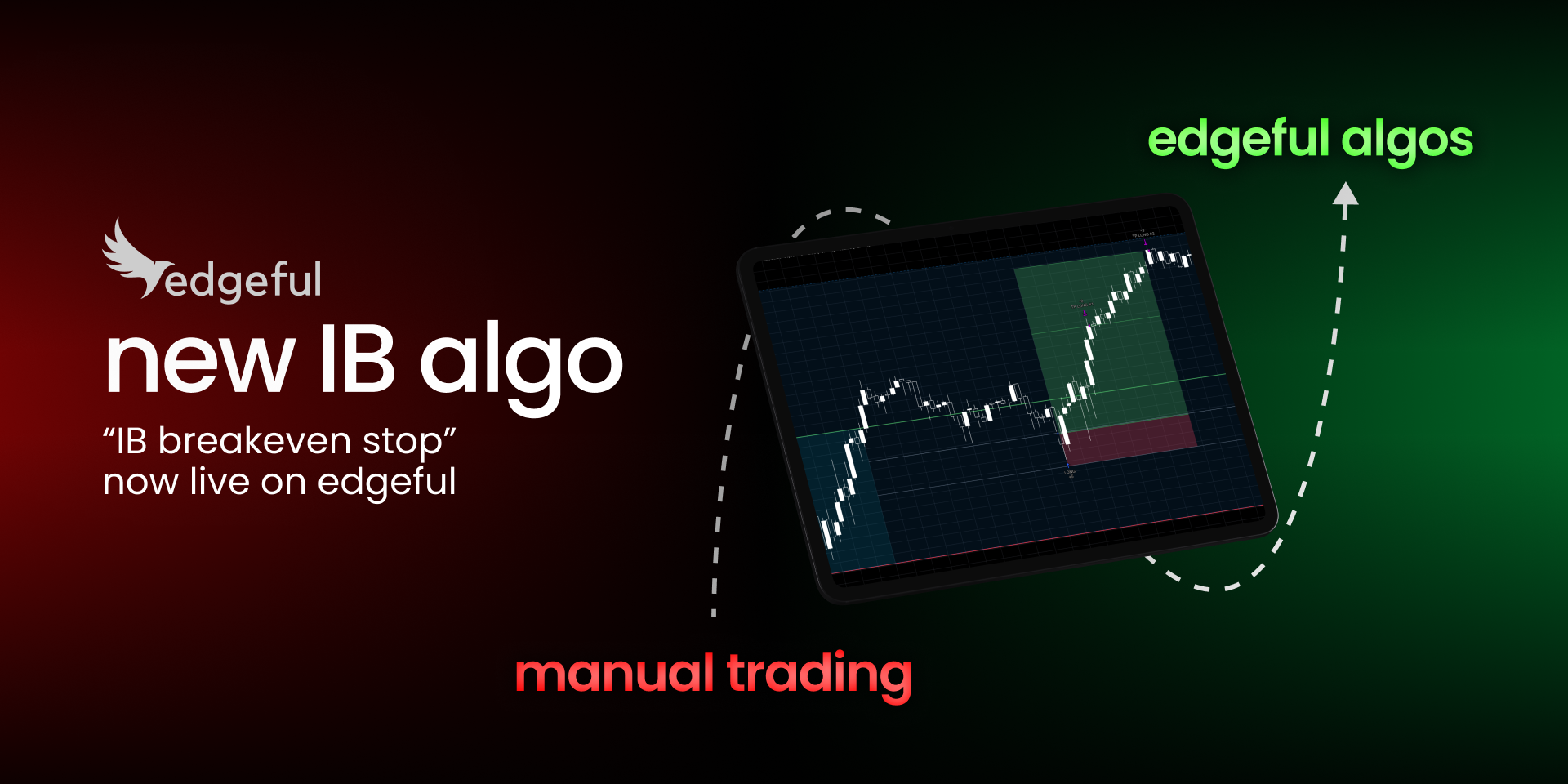
every trader has been here before — you're in a trade, price moves in your favor, you move your stop up... and then you get stopped out. and the first thing you think is, "did I move my stop too early?"
turns out, that question is the whole problem. you're making stop management decisions based on feel, not data. and the IB breakeven stop algo was built to fix exactly that.
the initial balance (IB) strategy has been one of the most consistent setups we've tracked over the last year. but even with a high-probability entry, most traders still sabotage themselves during the trade — either by moving their stop too early or not moving it at all. this algo removes that decision entirely by automating when and where your stop moves, all based on backtested criteria you can optimize before risking a single dollar.
here's everything you need to know.
the problem with manual stop management
most traders fall into one of two buckets when it comes to managing stops mid-trade:
- you move your stop too early, get stopped out, and then watch the trade go exactly where you wanted it to — without you.
- or you don't move it at all, watch all your unrealized profit evaporate, and take a full loss on a trade that was once green.
the problem in both cases is the same: there's no data behind the decision. it's 100% emotional. you're guessing when to move your stop and how far to move it.
I was on stream recently and experienced this firsthand. took a trade, price moved in my favor, I moved my stop up... and then got stopped out. the first thing I asked myself? "did I move my stop too early?"
turns out — price would've hit my original stop later anyway. so getting out at breakeven was actually the right call. but that feeling of "did I do it too soon?" is something almost every trader has dealt with.
and that's the core issue — when stop management is manual, the decision is emotional. you don't know if you're moving too early, too late, or to the wrong level. you're just reacting.
which brings up the question: what if you could backtest your stop management instead of guessing?
that's exactly what the IB breakeven stop algo lets you do.
what is the IB breakeven stop algo
if you already know the IB algo, this is an evolution of the same strategy. same ability to input your entry criteria, exit criteria, take profit levels, and adjust your account size and number of contracts — but now with a completely new layer of stop management built in.
for anyone brand new to the IB setup — the initial balance is the range formed by the high and low of the first hour of the trading session. once that range is set, the algo waits for a breakout or breakdown and enters on a retracement. if you want the full breakdown on the IB strategy, entry, stop loss, and profit targets — read this blog post.
this algo takes this proven setup and adds automated stop management on top. once your trade hits a specified profit level, the algo automatically moves your stop to breakeven — or into profit — without you touching anything.
no more "did I move my stop too early?" no more watching winners turn into losers because you didn't move it at all. the decision is made for you based on criteria you've already backtested.
the two new settings that change everything
this algo introduces two brand new parameters that give you full control over your stop management:
- trigger % to move stop loss — this tells the algo how far price needs to move in your favor before it moves your stop. set it to 100, and your stop only moves once TP1 is hit. set it to 50, and it moves when price is halfway to TP1.
- move stop loss % — this tells the algo where to move your stop to. set it to 0, and it moves to breakeven. set it to something higher, and it moves into profit — locking in gains.
here's why these two settings matter so much: instead of guessing, you can now backtest different combinations of trigger levels and stop placements to see exactly how they affect your bottom line. you can test "what happens if I move my stop to breakeven at TP1?" vs. "what happens if I move it at 50% of TP1?" — and let the data tell you which approach makes more money over time.
that kind of optimization was never possible with manual stop management. the IB breakeven stop algo makes it possible.
how the IB breakeven stop algo works in a real trade
let me walk you through a real example to show you how this algo handles a trade from start to finish.
here's what happened:
the short entry triggers after the IB low breaks and price retraces back to the entry level. price drops, hits TP1... and the algo automatically moves your stop to breakeven.
from there, price chops around — and if you were managing this by hand, you'd be second-guessing whether to move your stop to breakeven or not. should you lock in profits? should you give it more room? the internal debate starts.
but the algo already made the decision for you. and if price had reversed, you'd get out at breakeven instead of taking a full loss.
that's the whole point. the decision is no longer emotional — it's data-driven, it's backtested, and it's done for you, completely automated.
backtested performance of the IB breakeven stop algo on micro bitcoin (MBT1!)
to show you what this looks like in action, we ran the IB breakeven stop algo on micro bitcoin (MBT1!) over the last ~3.5 months (October 19, 2025 – February 6, 2026):
here are the results:
- +$2,171 (+21.71% on a $10,000 account trading 2 micros)
- 99 trades
- 75.76% win rate (75/99)
- 2.412 profit factor
- $608 max drawdown (5.06%)
important note: these settings are optimized using the optimization process outlined on our algos education page. the default settings won't produce these results — you need to run the optimization process yourself to find the best parameters for your ticker and timeframe.
but the fact that you can now include stop management in the backtest is a game changer. you don't have to rely on "feel" or guess when to move your stop. you can see exactly how different trigger levels affect your total P&L before you risk a single dollar.
if you're interested in trading bitcoin, we highly recommend micros (MBT) over minis because of leverage. the performance report above shows the results of trading just 2 micro contracts.
why backtesting your stop management matters
this is what makes this algo fundamentally different from just "moving your stop."
with manual stop management, you're making real-time decisions based on emotion. you see price moving, you react, and you hope it was the right call. there's no way to know ahead of time whether moving your stop at that level, at that time, was the optimal decision.
with this algo, you can actually backtest the questions that used to haunt you:
- how far should price run before I move my stop?
- should I wait for TP1? 50% of the way? 75%?
- where should I move it to — breakeven? into profit?
those aren't questions you should be answering in the moment while price is moving and your emotions are running. those are questions you should be testing before you ever enter a trade.
the data tells you the answer. you set the parameters. the algo executes.
automating the algo
this algo can be fully automated with Tradovate, NinjaTrader, or any prop firm that allows algos — including Apex Trader Funding, Tradeify, and My Funded Futures.
you optimize the backtest. you set up the automation. and the execution is handled for you — entries, exits, stop management, everything.
if your biggest struggle is emotional decision-making during trades, this is how you remove yourself from the equation. the algo handles the entry, the stop management, and the exit. your job is to optimize the settings and let it run.
and that's the whole philosophy behind what we're building at edgeful — taking the emotion out of trading and replacing it with data you can actually trust.
how to get started with the IB breakeven stop algo
if you want to run the IB breakeven stop algo yourself — or any of our other algos — head over to the algos page on edgeful.
here's what the process looks like:
- sign up for the algos plan and add your TradingView username during onboarding
- head to the algos education page to watch the key setup videos
- add the breakeven stop algo from your "invite only" section on TradingView indicators
- run the optimization process to find the best settings for your ticker
- set up automation with your broker and let the algo handle execution
the whole setup takes less than 10 minutes. and once you're running, the algo handles everything — entry, stop management, and exits — so you can stop guessing and start trading with data.
key takeaways
- the algo automatically moves your stop to breakeven (or into profit) once price hits your trigger level — removing emotion from stop management entirely
- two new settings give you full control: trigger % to move stop loss and move stop loss %
- you can now backtest your stop management for the first time — test different trigger levels and stop placements to see what produces the best results
- backtested results on MBT1! showed +21.71% return, 75.76% win rate, and only 5.06% max drawdown over ~3.5 months
- fully compatible with Tradovate, NinjaTrader, and prop firms that allow algos
- settings must be optimized — the default settings won't match the performance shown above
want more strategies, data breakdowns, and setups like this delivered to your inbox every week? join thousands of traders getting the stay sharp newsletter — it's free.
