
london session time: what time London opens in ET, all year
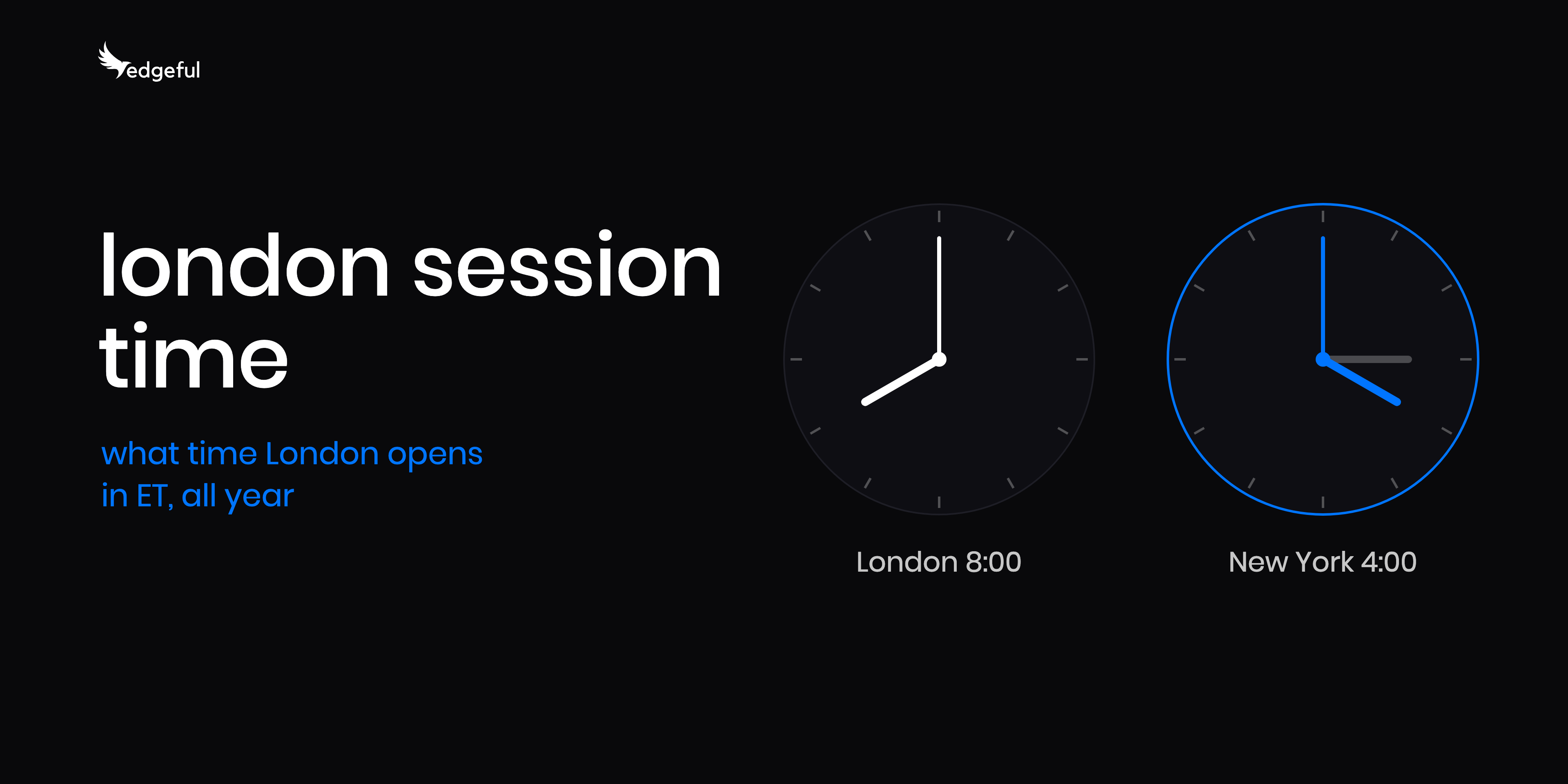
the London session time most traders have written down is 3AM ET. for most of the year, that's right. the London session opens at 8AM London time, and 8AM in London is 3AM in New York.
but for a few weeks every year, the UK and the US are on different clocks, and the London session time moves to 4AM ET. if your London range, your alerts, or your notes are set to 3AM ET during those weeks, they're an hour early.
according to edgeful data, on NQ over the last 12 months there were 20 of those days, and on 14 of them the 15-minute ranges from 3AM ET and 4AM ET broke first on opposite sides.
below is the answer to what time does the London session open in ET for every part of the year, the exact weeks it shifts, what those weeks looked like on NQ, and how we built the report behind those numbers with Claude.
table of contents
- what time does the London session open?
- why the London session time changes in March and October
- the London session time in EST for 2026 and 2027
- what the clock-change weeks did to the London session on NQ
- how we built the London session report with Claude
- how to build your own custom report
- common mistakes with the London session time
- key takeaways
what time does the London session open?
the London session opens at 8AM London time. in ET, that's:
- 3AM ET for most of the year
- 4AM ET for a few weeks in March, and for 1 week in late October or early November
the reason it's 3AM ET most of the year is that the UK and the US both move their clocks, so the gap between them stays at 5 hours. in winter, London is on GMT and New York is on EST. in summer, London is on BST and New York is on EDT. either way, 8AM in London is 3AM in New York.
the London session is the stretch of trading that runs from the London open into the New York morning. for futures traders, it matters because it's the first big session of the day after Asia, and a lot of traders mark the London range and trade off it before 9:30AM ET.
if you want the full breakdown of how the Asian, London, and New York sessions fit together, our trading sessions guide walks through all 3.
why the London session time changes in March and October
the UK and the US don't change their clocks on the same day.
- the US moves its clocks forward on the second Sunday of March, and back on the first Sunday of November
- the UK moves its clocks forward on the last Sunday of March, and back on the last Sunday of October
so twice a year, there's a stretch where one country has changed and the other hasn't. during those weeks, the gap between London and New York is 4 hours instead of 5, and the London session time in ET moves from 3AM to 4AM.
in March, the gap is 2 or 3 weeks long, depending on where the Sundays fall. in the fall, it's always 1 week, because the last Sunday of October is exactly 1 week before the first Sunday of November.
the London open itself doesn't move. it's 8AM in London every day of the year. what changes is what time that is in New York.
the London session time in EST for 2026 and 2027
here's when the London session time in ET is 4AM instead of 3AM (trading days, Monday to Friday):
- 2026, spring: Monday March 9 to Friday March 27
- 2026, fall: Monday October 26 to Friday October 30
- 2027, spring: Monday March 15 to Friday March 26
- 2027, fall: Monday November 1 to Friday November 5
every other trading day, the London session time in ET is 3AM.
a quick note on "EST": a lot of people search for the London session time in EST, but New York is only on EST in the winter. in the summer, it's EDT. the clock-change weeks happen right at the edges of that switch, which is a big part of why the London open time gets confusing. that's why the London session time in EST and in EDT is the same 3AM, except during those 4AM weeks.
what the clock-change weeks did to the London session on NQ
knowing the London session time is one thing. we wanted to see what happened on NQ during those weeks if you marked the range at the usual 3AM ET versus the actual London open.
so we built a custom report on NQ that compares 2 ranges on every out-of-sync day:
- the 15 minutes from 4AM ET, when London actually opened
- the 15 minutes from 3AM ET, the usual London open time
for each range, the report records which side broke first (the high or the low) before 9:30AM ET. all numbers below are NQ, 1-minute candles, over the last 12 months (October 24, 2025 to October 23, 2026), with every time in ET.
here's what it found:
- there were 20 out-of-sync days: October 27-31, 2025, and March 9-27, 2026
- on 14 of those 20 days, the 4AM ET range and the 3AM ET range broke first on opposite sides
- on the 4AM ET range, the low broke first on 14 of the 20 days. on the 3AM ET range, the high broke first on 12 of them
- on the 237 normal days in the same 12 months, the 15-minute London opening range broke both sides before 9:30AM ET 74.7% of the time
20 days isn't a lot of data, so I wouldn't trade off the high/low split. what I would do is move your London range to 4AM ET during those weeks. on most of these days, the 3AM ET range broke the other way first.
I also pulled up 10 of the March days on the 5-minute chart to check the report, and it had the first break right on all 10.
if you want to see how the London session relates to what happens after the New York open, we looked at that in does the London session predict New York?
how we built the London session report with Claude
edgeful doesn't have a report for just the clock-change days, so we asked Claude to build one.
custom reports are for the questions edgeful doesn't have a report for yet. you type the question in plain English, the same way you'd ask another trader, and it builds the report for you. Claude can build them through the edgeful connector, and they get saved under my reports in your edgeful account.
here's the prompt we used, shortened:
on NQ futures, build a report on the London 15-minute opening range. define the London open as 08:00 Europe/London local time, so it follows UK daylight saving time. for each trading day, record whether US and UK clocks were out of sync (the London open fell at 04:00 New York time instead of 03:00), the high and low of the 15-minute range starting at the London open, whether price broke above the high, below the low, both, or neither before 09:30 New York time, and which side broke first. summarize in-sync and out-of-sync days separately. on the out-of-sync days, compute the same stats for the 03:00-03:15 New York range so the two can be compared on the same days.
the key line is the first definition: the London open is 08:00 London time, not 3AM ET. once the report uses London's own clock, it handles the London session time change on its own.
it built the report in about 40 seconds, and by default, custom reports test the last 6 months of data. we ran this one on 12 months.
how to build your own custom report
if you trade a session, a time window, or a setup that edgeful doesn't have a report for, you can build it the same way:
- connect edgeful to Claude. in Claude, go to settings, then connectors, then add custom connector, and paste https://api.edgeful.com/mcp. the edgeful connector is on the pro and all access plans. our MCP setup guide walks through it step by step.
- turn on custom report writes in your edgeful API dashboard. building a report uses AI credits.
- describe the report. say which ticker, which time window, and exactly what you want counted. if something is unclear, it asks you before it builds.
- check the days. before you save it, look at a few of the days on your own chart.
- save it. it goes into my reports, and you can run it again on another ticker or date range.
the most useful custom reports are usually about how you trade. if you trade ORB breaks, you could ask how far NQ tends to run past the ORB high before it comes back inside the range, and use that to decide where your stop goes.
a few more to try:
- how often does the NQ low of the day form between 11:00 and 11:15AM ET?
- after 3 green days in a row on ES, how often is day 4 green?
- how often does Friday make the high of the week on NQ?
if you want to go deeper on connecting AI tools to market data, our trading data MCP guide covers Claude, ChatGPT, and Cursor.
common mistakes with the London session time
using a fixed ET time all year. the London session time is 3AM ET most of the year, not every day of the year. a fixed 3AM ET alert is an hour early during the clock-change weeks.
assuming both countries change on the same weekend. they don't. the US changes first in March, and the UK changes first in October.
mixing up EST and EDT. New York switches between EST and EDT, but the London open time stays at 3AM ET either way, except when the two countries are out of sync. the 4AM weeks are the ones where only one side has changed.
trusting a session indicator without checking it. if your charting platform marks the London session in ET, check whether it follows London's clock or a fixed ET time. if it's a fixed ET time, the London box is in the wrong place for those weeks.
comparing London stats across years without the shift. if you're looking at London session stats on NQ over several years, a fixed 3AM ET range mixes in a few weeks a year where you weren't measuring the London open at all.
key takeaways
- the London session time is 8AM London time, which is 3AM ET for most of the year
- for 2-3 weeks in March and 1 week in late October or early November, the London session time is 4AM ET
- in 2026 those weeks are March 9-27 and October 26-30. in 2027 they're March 15-26 and November 1-5
- according to edgeful data, on NQ over the last 12 months, the 15-minute ranges from 3AM ET and 4AM ET broke first on opposite sides on 14 of the 20 clock-change days
- 20 days is a small sample, so use the NQ result to move your London range to 4AM ET during those weeks, and don't trade the high/low split
- a custom report that defines the London open in London time handles the London session time change on its own
- you can build reports like this with Claude through the edgeful connector, and they save to my reports in your edgeful account
edgeful provides historical performance data to help traders make informed decisions. this does not constitute financial advice. past performance is not indicative of future results. all trading involves risk. always do your own analysis and manage your risk accordingly.
