
inside day in trading: what the breakout data says across ES, NQ, TSLA, and NVDA
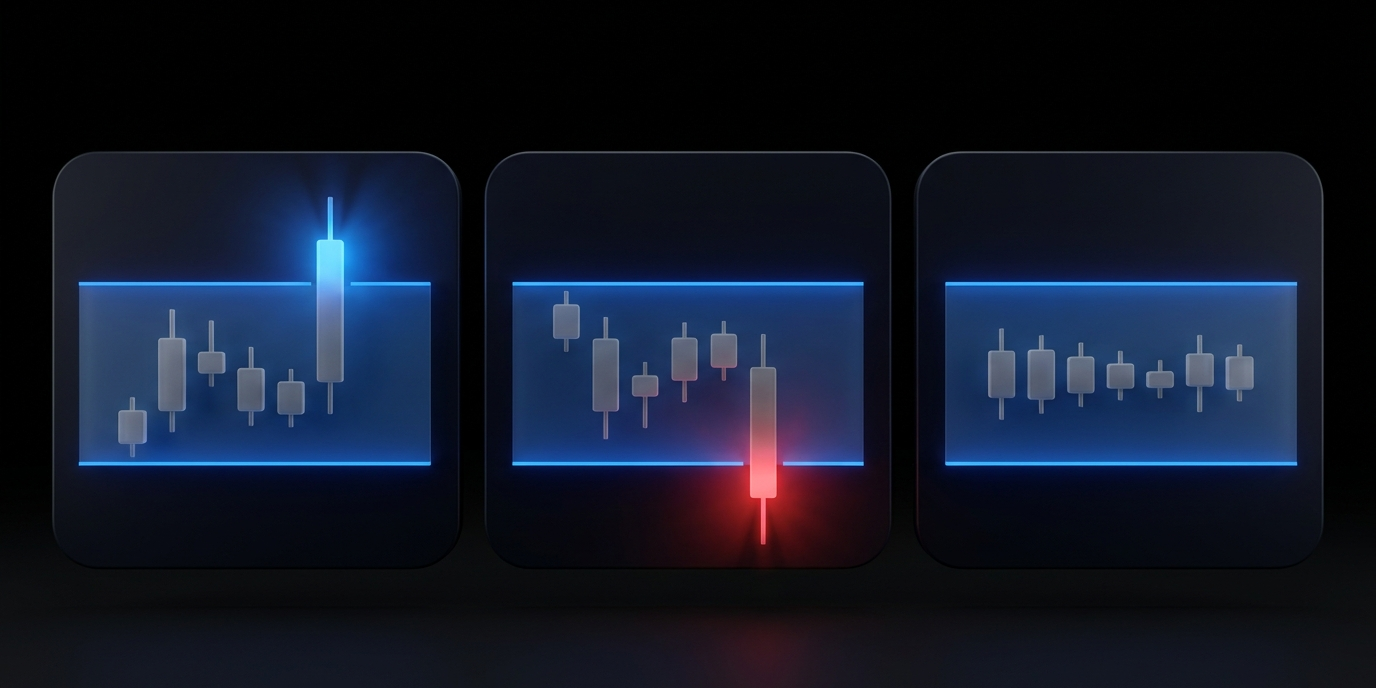
an inside day is one of the most common setups in trading, and most traders completely ignore it. every morning, price either opens within yesterday's range or beyond it. when it opens inside, something specific tends to happen next. and the data across ES, NQ, TSLA, and NVDA over the last 6 months makes that pattern hard to ignore.
in this post, I'm going to break down what an inside day actually is, what the breakout data shows across 4 of the most traded tickers, and how you can use that data to set better profit targets in your own trading.
table of contents
- what is an inside day in trading
- inside day breakout data across ES, NQ, TSLA, and NVDA
- how to determine direction on an inside day
- real examples: when the breakout hits (and when it doesn't)
- how to use the data to set profit targets
- common mistakes traders make on inside days
- key takeaways
what is an inside day in trading
an inside day happens when price opens within the previous session's range. that means the open is below yesterday's high and above yesterday's low. you pull up your chart in the morning, and the open is sitting somewhere between those two levels. some traders refer to this as an inside day candle or a candlestick inside day, but the concept is the same regardless of what you call it.
the opposite is an outside day, where price opens beyond yesterday's range. outside days have their own set of tendencies, but this post is focused on what happens when the open stays contained.
the key question with the inside day pattern is simple: does price stay trapped within yesterday's range all session? or does it break out to reach yesterday's high or low at some point during the day?
that's exactly what the breakout data answers. and the results are consistent across multiple tickers and timeframes.
most traders see this pattern and don't think anything of it. they treat it like any other session. but the data says otherwise. when you know how often price breaks out of yesterday's range on these days, you have a specific, data-backed level to aim for. and that changes how you approach your targets.
inside day breakout data across ES, NQ, TSLA, and NVDA
here's what the last 6 months of data shows during the NY session (9:30 AM to 4:00 PM ET):
- ES (S&P 500 futures)
- 87.84% broke out of yesterday's range (65 out of 74 qualifying sessions)
- 12.16% stayed inside (9 out of 74)
- NQ (Nasdaq futures)
- 88.41% broke out (61 out of 69 qualifying sessions)
- 11.59% stayed inside (8 out of 69)
- TSLA
- 87.36% broke out (76 out of 87 qualifying sessions)
- 12.64% stayed inside (11 out of 87)
- NVDA
- 81.33% broke out (61 out of 75 qualifying sessions)
- 18.67% stayed inside (14 out of 75)
the pattern is consistent across all 4 tickers. when price opens within yesterday's range, it breaks out to reach yesterday's high or low somewhere between 81% and 88% of the time.
according to edgeful data, the average breakout rate across these tickers is roughly 86%. that means on approximately 6 out of every 7 qualifying sessions, price reaches yesterday's high or low at some point during the day.
for a deeper dive into the inside day pattern from a candlestick perspective and how to build a full inside bar trading strategy, we covered that in a separate post.
what matters here is the implication. if you're trading on one of these days and you don't know where to set your target, the data gives you a clear answer: yesterday's high or low. price gets there the vast majority of the time.
how to determine direction on an inside day
the breakout data tells you that price will likely reach one of yesterday's levels. but it doesn't tell you which one. for that, you need a way to read direction.
one approach uses the midpoint of yesterday's range. this is exactly what edgeful's "by open" subreport analyzes. it looks at where price opens relative to yesterday's midpoint and tracks which side of the range is more likely to break.
here's what the data shows on NQ over the last 6 months:
when today's open is above yesterday's midpoint, price touches the prior session's high 67% of the time. the midpoint acts as a dividing line. opening above it gives you a slight bullish lean.
when today's open is below yesterday's midpoint, price touches the prior session's low 58% of the time. this gives you a slight bearish lean, though the edge is smaller on the downside.
this is useful because it narrows down which level to target. instead of waiting to see which side of yesterday's range breaks, the midpoint gives you a data-backed read on direction before the session even gets moving.
you can also pair this with other data. the initial balance report can tell you which side of the first hour range is more likely to break. opening candle data can give you a bias based on the first 15 or 60 minutes. these aren't competing signals. they're additional data points that help you build confidence in your directional read.
the concept is simple. the breakout data gives you the target. other reports, or your own analysis, give you the direction. they work together.
real examples: when the breakout hits (and when it doesn't)
ES on Friday, April 25: breakout to Thursday's high
ES opened Friday within Thursday's range. below Thursday's high, above Thursday's low. a textbook setup.
the data says that on ES, 87.84% of the time when this happens, price breaks out to reach one of yesterday's levels. and that's exactly what played out. price rallied through the session and hit Thursday's high.
if you had a long bias that morning from the IB report, the midpoint data, or your own read, Thursday's high was your target. the data told you where to aim. and price got there.
that's the whole framework. you identify the setup, use data to pick a direction, and target yesterday's high or low.
TSLA on Friday, April 25: stayed within Thursday's range
now here's the other side.
TSLA opened Friday around $376, within Thursday's range. Thursday's high was up near $386. Thursday's low was down around $369. price chopped around all session and never came close to either level.
this happens about 12.64% of the time on TSLA. it's the minority outcome, but it does happen. and when it does, yesterday's high and low act more like a ceiling and a floor that price never reaches.
this is an important part of the picture. 87% is strong, but roughly 1 out of every 8 of these setups on TSLA, the breakout doesn't happen. price stays trapped.
that's why position sizing and stop placement still matter. the data gives you the target, but you still need to manage the trade for the times it doesn't work out. an 87% breakout rate is not 100%. and treating it like a certainty is one of the fastest ways to give back your gains.
how to use the data to set profit targets
if you're inside day trading on any of these tickers, the targeting question is the one that matters most. and most traders set targets based on feel. they pick a round number, or they hold until they get nervous, or they move their target after the trade is already running. the result is inconsistent exits and a P&L that doesn't match the setups they're finding.
the breakout data gives you a different approach.
when price opens within yesterday's range, yesterday's high and low become data-backed targets. levels that price reaches 81% to 88% of the time across ES, NQ, TSLA, and NVDA over the last 6 months in the NY session.
here's the process:
- check if today qualifies. is the open between yesterday's high and yesterday's low? if yes, the breakout data is in play.
- determine direction. use the midpoint of yesterday's range, the IB report, or your own analysis to figure out which side is more likely to break.
- set your target at yesterday's high or low. if your bias is long, target yesterday's high. if bearish, target yesterday's low. these are the levels the data says price reaches the vast majority of the time.
- manage the trade. the data gives you the target, not the entry. your entry method is separate. and your stop placement should account for the 12% to 19% of sessions where price stays trapped within yesterday's range.
this is the same process we break down in our post on data-backed profit targets. the concept applies across multiple reports: use the data to pick specific levels, not feelings.
the key point is that inside day trading data doesn't replace your trading plan. it improves one specific part of it: knowing where to aim. and that's the part most traders get wrong.
common mistakes traders make on inside days
mistake 1: treating the setup as a standalone strategy
the breakout data tells you where price is likely to go. it does not tell you when to enter, where to place your stop, or what size to trade. it's one piece of the puzzle, not the whole picture.
traders who use this data effectively pair it with direction from other sources. treating the breakout rate as a full strategy leads to inconsistent results because you're missing the timing and risk management pieces.
mistake 2: ignoring the stay-inside rate
an 87% breakout rate on ES sounds great. and it is. but that also means roughly 1 out of every 8 qualifying sessions, the breakout never comes. traders who size up aggressively because "it works 87% of the time" are setting themselves up for an outsized loss on the sessions it doesn't.
position sizing and stop placement aren't optional just because the numbers are in your favor. inside day trading gives you an edge, not a guarantee.
mistake 3: using stale data as if it's permanent
the breakout rates I showed you are from the last 6 months. market conditions change. the numbers from 6 months ago won't be identical to the numbers 6 months from now.
this is why it's important to check the live stats regularly. a level that hits 88% of the time in one market environment might drop to 72% in a different one. the edge is still there, but the size of it shifts. treating old data as permanent is how traders lose confidence when their results don't match their expectations.
as we covered in our post on why most traders get previous day's range levels wrong, static levels without updated data behind them lead to poor decisions.
mistake 4: not having a plan for when the breakout fails
the 12% to 19% of sessions where price stays within yesterday's range aren't random noise. they're a real part of the pattern. you need a plan for those days.
that might mean a time-based exit if price hasn't broken out by a certain point in the session. or it might mean a tighter stop that limits your downside when the setup doesn't follow through. whatever your approach, the important thing is having one before the trade starts.
key takeaways
- an inside day happens when price opens within yesterday's high and low. it's one of the most common daily setups across futures and stocks.
- according to edgeful data, these setups break out to reach yesterday's high or low between 81% and 88% of the time across ES, NQ, TSLA, and NVDA over the last 6 months during the NY session.
- the midpoint of yesterday's range helps determine direction. on NQ, opening above the midpoint leads to the prior high being touched 67% of the time. opening below leads to the prior low 58% of the time.
- yesterday's high and low become data-backed profit targets on inside days. instead of setting targets based on feel, you're using levels that price historically reaches the vast majority of the time.
- the breakout rate is not 100%. roughly 1 out of every 7-8 qualifying sessions, price stays within yesterday's range. stops and position sizing still matter.
- this data works best when paired with directional reads from the IB report, the opening candle, or your own analysis. it answers "where to aim," not "which direction."
- market conditions change. always check the live data rather than relying on old numbers.
risk disclaimer: past performance does not guarantee future results. all statistics shown reflect historical data over the specified timeframe. trading involves risk, and results depend on individual strategy, customization, and effort. edgeful provides data, not financial advice.
