
day trading vs scalping: which style fits you best?
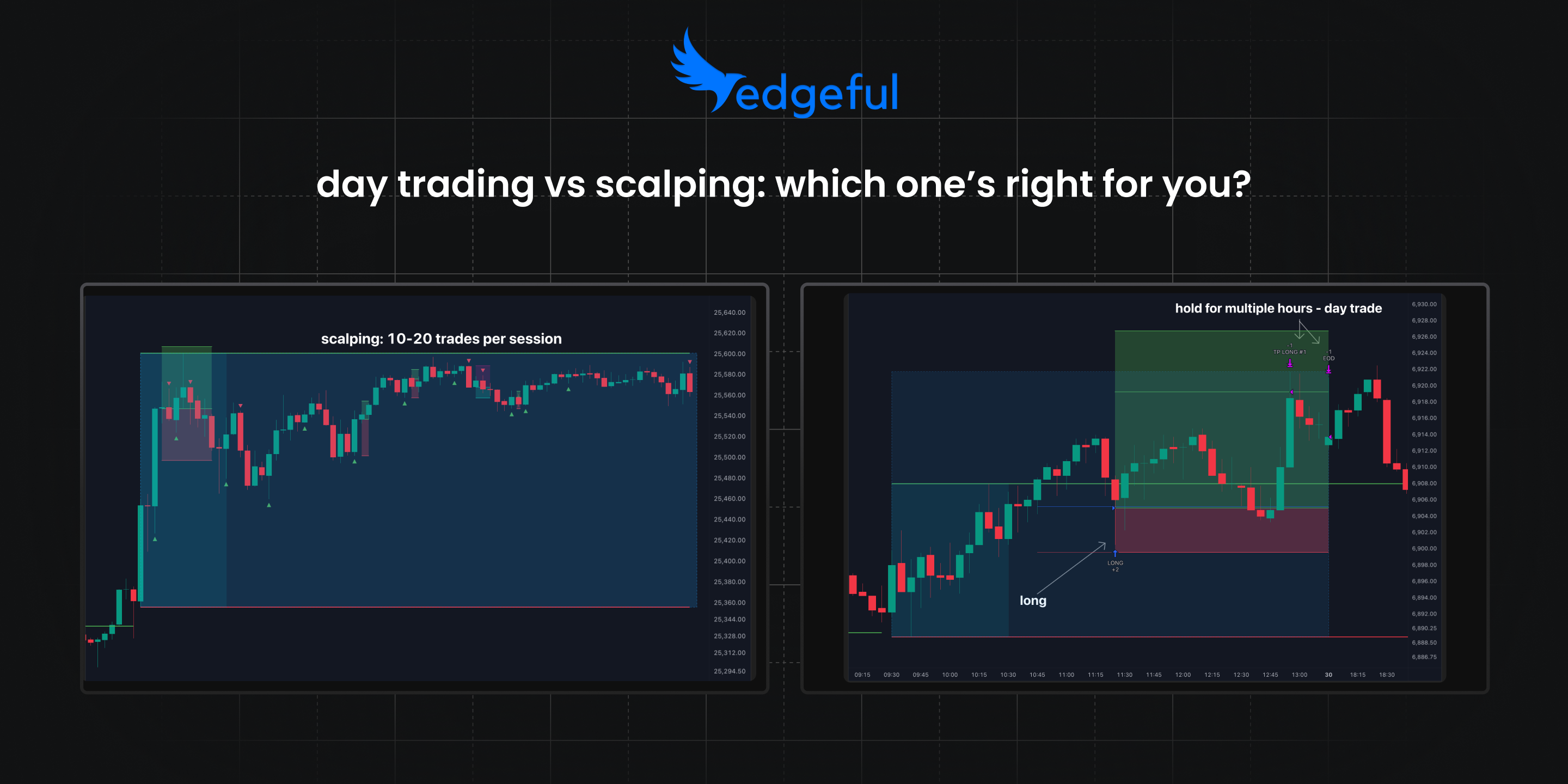
most traders pick their trading style based on what sounds exciting — not what actually fits their personality, schedule, and risk tolerance.
they see a scalper making 50 trades a day and think "that's where the money is." or they hear about a day trader holding positions for hours and assume it's less stressful.
both assumptions are wrong.
day trading and scalping are fundamentally different approaches to the market. they require different mindsets, different setups, and different levels of time commitment. choosing the wrong one doesn't just cost you money — it burns you out.
the good news? once you understand the real differences between day trading vs scalping, picking the right style becomes obvious. and when your style matches your personality, trading gets a lot easier.
let's break down what actually separates these two approaches — and how to figure out which one fits you.
table of contents
- what is day trading?
- what is scalping?
- 7 key differences between day trading and scalping
- which setups work best for each style
- how to choose your trading style
- combining both approaches
- frequently asked questions
- key takeaways
what is day trading?
day trading means opening and closing positions within the same trading day. you never hold overnight. but unlike scalping, you're not trying to catch every small move — you're looking for larger intraday swings.
typical day trading characteristics:
- holding time: 15 minutes to several hours
- trades per day: 1-5 quality setups
- profit targets: 10-50+ points on ES/NQ (varies by instrument)
- approach: wait for high-probability setups, let trades develop
day traders focus on fewer, higher-conviction trades. instead of jumping in and out constantly, they wait for specific conditions — like an initial balance breakout or a gap fill setup — and then ride the move.
the mental game is different too. day trading requires patience. you might watch the market for an hour before your setup triggers. when it does, you need the discipline to hold through pullbacks rather than closing too early.
for traders who want market exposure without the stress of constant decision-making, day trading offers a middle ground between scalping and swing trading.
what is scalping?
scalping is the fastest form of trading. you're in and out of positions within seconds to minutes, capturing small price movements over and over.
typical scalping characteristics:
- holding time: seconds to 15 minutes
- trades per day: 10-100+ trades
- profit targets: 2-10 points on ES/NQ (small, consistent gains)
- approach: high frequency, quick decisions, tight risk management
scalpers don't care about the big picture. they're not trying to catch the full move — they're skimming small profits repeatedly. a scalper might make 5 points on ES twenty times in a day rather than trying to catch one 100-point move.
this requires intense focus. you're making rapid decisions constantly. there's no time to second-guess. you see the setup, you take it, you manage it, you exit. then you do it again.
scalping works best during high-volatility periods — the market open, news events, session overlaps. when price is moving fast, scalpers thrive. when the market is choppy or slow, scalping becomes a grind.
for traders who love action and can make quick decisions without hesitation, scalping offers constant engagement with the market.
7 key differences between day trading and scalping
understanding these differences helps you pick the style that matches how you naturally think and trade.
1. holding time
scalping: seconds to 15 minutes. you're not waiting around.
day trading: 15 minutes to several hours. patience is required.
2. trade frequency
scalping: 10-100+ trades per day. looking for more consistent activity throughout the trading session.
day trading: 1-5 trades per day. a little more selective with entries and trades, not trying to capture every single move, just the biggest of the day.
3. profit targets
scalping: small targets (2-10 points on ES). you're taking what the market gives quickly.
day trading: larger targets (10-50+ points on ES). you're letting winners run holding to capture "bigger" moves.
4. risk per trade
scalping: very tight stops (2-5 points). small risk, small reward, repeated often.
day trading: wider stops (10-20+ points). larger risk, larger reward, fewer trades.
5. time commitment
scalping: requires constant screen time. hard to be a scalper during the work day if you have a separate job.
day trading: can set alerts and step away. less intensive monitoring and often times work well with a day job if you know when your trades usually trigger..
6. emotional intensity
scalping: high intensity, rapid decisions. emotionally demanding but short bursts.
day trading: lower intensity per trade but requires patience through drawdowns.
7. account size & capital requirements
scalping: commissions add up fast with high volume. need enough capital to absorb transaction costs.
day trading: fewer trades means lower commission impact. more forgiving for smaller accounts.
which setups work best for each style
not every setup works for every trading style. here's what matches each approach.
best setups for scalping
scalpers need fast-moving, high-probability setups that resolve quickly.
- opening range breakout (ORB): the first 5-15 minutes set the tone. scalpers trade the initial break of that range for quick moves. check out our ORB trading strategy guide for the data behind this setup.
- engulfing candles on lower timeframes: when you see an engulfing pattern on a 1-minute or 5-minute chart during high-volume periods, that's a scalper's signal.
- quick reversals at key levels: previous day's high/low, round numbers, VWAP — scalpers fade or follow these reactions for fast profits.
best setups for day trading
day traders need setups with room to run and clear invalidation points.
- initial balance breakout: the first hour's range often defines the day. when price breaks the IB high or low, day traders ride that move for extended targets. our initial balance breakout strategy guide covers the probabilities.
- gap fills: when the market gaps up or down, there's often a move back to fill that gap. day traders can hold these trades for hours as they develop.
- trend continuation after the morning range: once the opening chaos settles, trends often emerge. day traders identify direction and hold positions through the session.
the common theme between both styles
both styles benefit from understanding probabilities. whether you're scalping the open or day trading an IB breakout, knowing the historical win rate of your setup gives you an edge.
that's where edgeful's reports come in — you can see exactly how often these setups work across different instruments and sessions.
how to choose your trading style
forget what looks cool or what your favorite trader does. focus on what matches YOU.
choose scalping if:
- you thrive under pressure and make quick decisions easily
- you have 2-4 hours of uninterrupted screen time during market hours
- you prefer constant action over waiting
- you're comfortable with high trade volume and can manage commissions
- you can detach emotionally from individual trades (win or lose, move on)
choose day trading if:
- you prefer patience over constant activity
- you have a job or responsibilities that prevent constant screen watching
- you want fewer decisions with more time to think
- you're comfortable holding through pullbacks without panicking
- you'd rather take 3 good trades than 30 mediocre ones
the honest self-assessment
when deciding between day trading and scalping, ask yourself this question:
when a trade goes against you, what's your instinct?
- if your first reaction is to cut it immediately and move to the next opportunity — scalping fits your psychology.
- if your first reaction is to check whether your thesis is still valid and give it room — day trading fits better.
neither response is wrong. but trading against your natural instincts is a losing game.
combining both approaches
who says you have to choose just one?
many successful traders use a hybrid approach: scalp the open, then transition to day trading once the initial balance forms.
how the hybrid works:
- first 30-60 minutes: the market open is volatile and fast-moving. this is prime scalping territory. take quick trades on ORB setups, fade overextensions, capture the early momentum.
- after the initial balance forms: volatility typically decreases. now you have context — the IB high and low are set. switch to day trading mode. look for IB breakouts or trend continuation setups that you can hold for hours.
why this works:
- you capture the high-probability opportunities at the open
- you don't force scalp trades during slow midday chop
- you adapt your style to what the market is giving you
the key is knowing when to switch. if you're still scalping at 11 AM when volume has dried up, you're forcing it. if you're trying to day trade the first 15 minutes of chaos, you're fighting the market's nature.
for a deeper look at how to adapt to different market conditions, check out our day trading strategies for beginners guide.
frequently asked questions
is scalping more profitable than day trading?
neither is inherently more profitable. scalping can generate consistent small gains but requires high accuracy and volume. day trading captures larger moves but requires patience and fewer opportunities. profitability depends on execution, not style.
which is better for beginners — day trading or scalping?
day trading is generally easier for beginners. the slower pace gives you time to think and learn. scalping requires fast decisions that most new traders aren't ready for. start with day trading, then explore scalping once you've built foundational skills.
can you scalp and day trade the same account?
yes. many traders scalp the market open and transition to day trading later in the session. just be clear about which mode you're in — don't let a scalp turn into a day trade because you're hoping it recovers.
how much capital do you need for scalping vs day trading?
scalping requires enough capital to absorb commission costs across high trade volume. day trading is more forgiving since you're taking fewer trades. for futures, both styles benefit from the lack of PDT restrictions, but scalpers need to factor in per-trade costs more carefully.
what's the biggest mistake traders make when choosing a style?
choosing based on what they think will make the most money rather than what fits their personality. a patient person trying to scalp will overtrade and burn out. an action-oriented person trying to day trade will exit too early or force trades out of boredom.
key takeaways
- day trading means holding 15 minutes to several hours, taking 1-5 trades per day with larger targets
- scalping means holding seconds to 15 minutes, taking 10-100+ trades per day with small targets
- the 7 key differences: holding time, trade frequency, profit targets, risk per trade, time commitment, emotional intensity, and capital requirements
- scalping works best with ORB setups and quick reversals at key levels
- day trading works best with initial balance breakouts and gap fill setups
- choose based on your personality and schedule — not what looks exciting
- many traders combine both: scalp the open, day trade after IB forms
your trading style should match who you are — not who you think you should be.
figure out your natural tendencies. pick the approach that fits. then master it.
