
best futures to trade: a data-driven comparison of 6 contracts
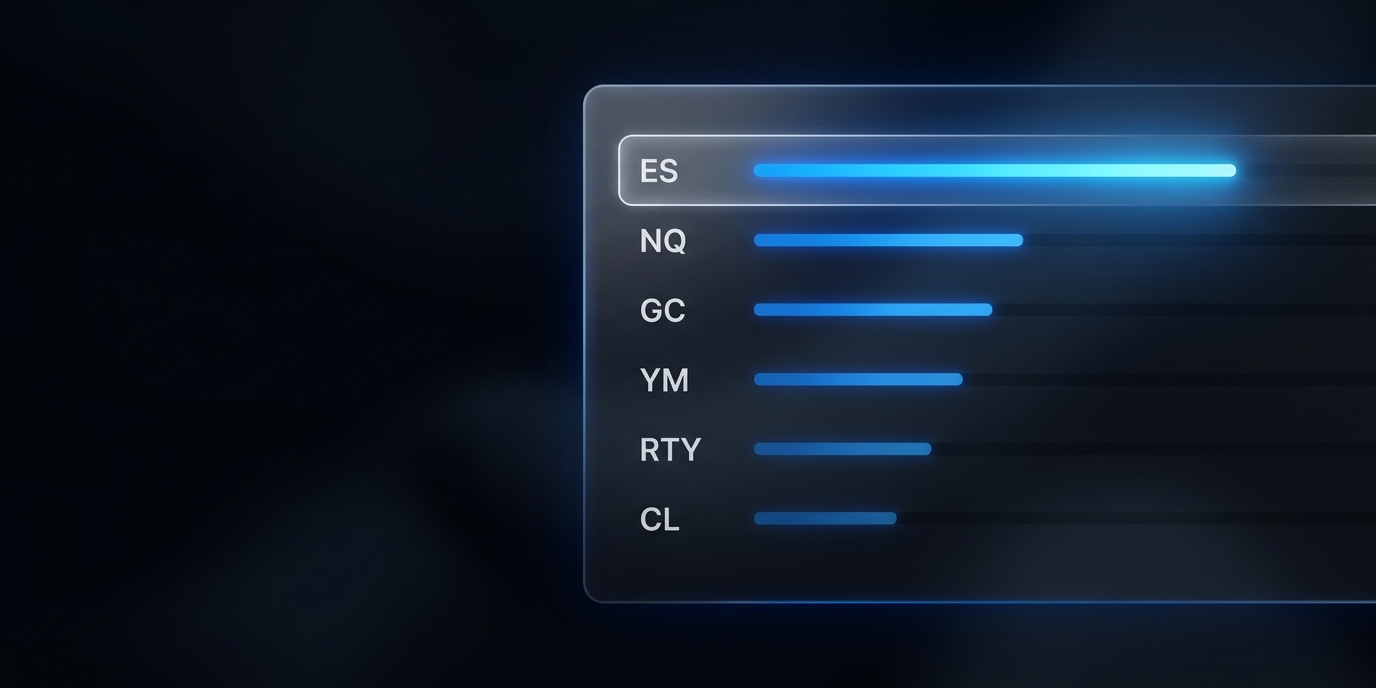
if you're trying to figure out the best futures to trade, you're not alone. it's one of the most common questions new futures traders ask — and most of the answers out there are based on opinions, not data.
the problem is that every contract has a different personality. different tick values, different volatility, different session behavior, different risk profiles. what works for a funded trader with a $150k account isn't going to work for someone starting with $5k. and what works during the NY session might fall apart in the overnight.
I’ve worked with thousands of traders through edgeful, and the ones who pick the right contract early on tend to stick around longer. the ones who jump into something too volatile, too expensive, or too illiquid... they blow an account and disappear.
so let's break down which futures to trade — and why — with actual data.
table of contents
- quick comparison: 6 best futures contracts to trade
- ES — the benchmark everyone starts with
- NQ — bigger moves, bigger risk
- GC — gold and the IB edge
- CL — crude oil for experienced traders
- YM — the dow for continuation traders
- RTY — small caps, big volatility
- which futures contract should you trade first
- how edgeful data helps you pick the right contract
- common mistakes when choosing futures to trade
- key takeaways
quick comparison: 6 best futures contracts to trade
here's a side-by-side look at the most popular futures to trade. this covers the core specs you need to compare before committing capital to any of these.
contract specs:
the first thing you'll notice is the range in point values. CL at $1,000/point is in a completely different universe from YM at $5/point. that alone should tell you that not every contract is right for every account size.
now let's dig into each one.
ES | the benchmark everyone starts with
ES is the most traded futures contract in the world, and there's a reason it's the default recommendation for new traders. it tracks the S&P 500, which means you're trading a broad basket of 500 US companies rather than a single sector.
at $50/point and $12.50/tick, ES gives you meaningful position sizes without the extreme per-tick risk of something like CL. and if $12.50/tick is still too much, the micro version (MES) drops that down to $1.25/tick — which is where most beginners should start.
why traders pick ES
- liquidity. ES is the deepest futures market out there. tight spreads, fast fills, minimal slippage in normal conditions
- consistency. the S&P 500 is the most referenced benchmark in finance. ES tends to have more predictable intraday patterns compared to single-sector instruments
- data coverage. on edgeful, ES has a full suite of reports — gap fills, IB (standard, by retracement, by rejection, by weekday), ORB (by levels, by retracement, by performance), outside days, engulfing candles, previous day's range, OCC, ICT midnight retracement, and the screener
what to watch out for
ES can feel "slow" compared to NQ. if you're trading small position sizes, the moves might not generate enough profit to feel worthwhile. that's not a flaw in the contract — it's a sign you might need to adjust expectations or account size.
the most popular reports to track on ES are the gap fill report, ORB, and IB reports.
we covered the ES vs NQ comparison in detail in our post on ES vs NQ: which index fits your trading style & account size. if you're torn between these two, that breakdown is worth reading.
NQ | bigger moves, bigger risk
NQ tracks the Nasdaq-100 — 100 of the largest non-financial companies on the Nasdaq, heavily weighted toward tech (think Apple, Microsoft, NVIDIA, Meta). that concentration means NQ moves more aggressively than ES on most days.
at $20/point and $5/tick, the per-tick cost is actually lower than ES. but don't let that fool you. NQ's daily range is significantly wider, so the dollar risk on a typical trade is often higher than ES despite the smaller point value.
why traders pick NQ
- bigger moves. for traders who want more range to work with, NQ delivers. larger intraday swings mean more opportunity for breakout and momentum strategies
- tech exposure. if you follow tech earnings, AI hype cycles, and semiconductor news, NQ reacts to those catalysts more directly
- algo performance. NQ is the primary instrument for edgeful's algo backtests. the ORB algo with 2 take-profit targets was built and optimized specifically on NQ
what to watch out for
NQ is not the best futures contract for beginners. the volatility that creates opportunity also creates risk. a 20-point move on NQ at $20/point is $400 per contract and 20-point moves happen quickly on NQ.
traders who use multiple edgeful reports together on NQ, like stacking the gap fill direction with the IB break, tend to find cleaner setups.
GC | gold and the IB edge
gold futures trade on COMEX (part of CME Group) and offer something the equity index futures don't, which is commodity exposure. GC is driven by a mix of inflation expectations, central bank policy, geopolitical risk, and dollar strength. it moves on a different set of catalysts than ES or NQ, which makes it useful for diversification.
at $100/point and $10/tick, GC sits in the middle of the pack on cost. the micro version (MGC) at $10/point and $1/tick makes it accessible for smaller accounts.
why traders pick GC
- IB continuation. GC has historically shown one of the highest single-break rates on the initial balance report. when gold breaks one side of the IB range and doesn't look back, it tends to keep going. this makes GC ideal for continuation traders who use the IB strategy
- different catalysts. trading GC alongside ES or NQ gives you exposure to different market drivers. when equity index futures are choppy, gold might be trending cleanly
- strong edgeful coverage. GC has IB (standard, by retracement, by rejection, by weekday), gap fills, ORB, outside days, previous day's range, and the screener on edgeful
what to watch out for
GC can gap significantly on overnight geopolitical events. and because it's a commodity, inventory reports, central bank meetings, and macroeconomic data releases can cause sudden, sharp moves that don't follow the typical technical patterns.
for a deep look at the GC IB algo strategy, check out our post on GC trading strategy: the initial balance algo that returned $106k in 12 months.
CL | crude oil for experienced traders
crude oil futures (CL) track WTI (West Texas Intermediate) on NYMEX. this is a different animal from equity index futures. supply/demand dynamics, OPEC decisions, inventory data (EIA weekly reports), and geopolitical events drive price — not earnings reports or tech sentiment.
at $1,000/point and $10/tick, CL is the most expensive contract on this list in terms of per-point exposure. a 1-point move on CL is $1,000. that's not a typo. the micro version (MCL) brings it down to $100/point and $1/tick, which is more manageable for most traders.
why traders pick CL
- massive range. CL regularly puts in large daily ranges, which means plenty of room for intraday strategies — if you can manage the risk
- different market dynamics. CL's price action is driven by fundamentals that are completely separate from equities. for traders who want to trade the commodity space, CL is the most liquid option
- inventory data edge. weekly EIA crude oil inventory reports create predictable volatility windows that some traders specialize in
what to watch out for
CL is not forgiving. the per-point value means that even small mistakes are expensive. slippage during fast-moving events (like an unexpected OPEC headline) can blow through stops. and the bid/ask spread can widen during off-hours more than equity index futures.
this is genuinely one of the hardest futures markets to trade consistently. the traders i've seen do well on CL have significant experience and tight risk management. it's not where you want to start.
YM | the dow for continuation traders
YM tracks the Dow Jones Industrial Average — 30 large-cap US companies. at $5/point and $5/tick, YM has the smallest tick value of any major equity index futures contract. that makes it one of the easiest futures to trade from a risk-per-tick perspective.
the micro version (MYM) drops to $0.50/point and $0.50/tick, which is about as low-risk as futures trading gets.
why traders pick YM
- lowest tick value. at $5/tick on the E-mini and $0.50/tick on the micro, YM is the most accessible major index futures contract for small accounts
- continuation patterns. on edgeful, YM is the go-to instrument for OCC (opening candle continuation) and green/red streak analysis. it's also the example instrument for the "by spike" subreport, which shows how much adverse movement to expect before a reversal
- steadier moves. YM tends to have less violent intraday whipsaws compared to NQ. the 30-stock composition smooths out some of the single-stock volatility
what to watch out for
YM's smaller moves mean smaller profits per contract. if you're used to NQ's range, YM can feel sluggish. you'll need to either trade more contracts or accept smaller per-trade returns.
RTY | small caps, big volatility
RTY tracks the Russell 2000 — 2,000 small-cap US companies. it behaves differently from ES and NQ because small caps respond to different economic forces. when interest rates drop and domestic economic data is strong, RTY tends to outperform. when large-cap tech is leading, RTY can lag.
at $50/point and $5/tick, RTY has the same point value as ES but a smaller tick size (0.10 vs 0.25 points). the micro version (M2K) is $5/point and $0.50/tick.
why traders pick RTY
- decorrelation. RTY doesn't move in lockstep with NQ or ES. when the major indices are choppy or rangebound, RTY sometimes provides cleaner trends
- small-cap exposure. for traders who follow domestic economic data, rate decisions, and small-cap earnings, RTY is a more direct play than the large-cap indices
- mean reversion. RTY tends to show strong mean reversion characteristics, which can work well with gap fill and IB strategies
what to watch out for
RTY can be thin compared to ES and NQ. wider spreads, more slippage, and less predictable behavior during low-volume sessions. it's also more sensitive to economic data releases and rate decisions, which can cause sharp, fast moves that are hard to manage.
RTY is available on edgeful's screener as one of the major index futures, and it's included in sentiment analysis alongside ES, NQ, and YM for building a multi-ticker daily bias.
which futures contract should you trade first
this is the question everyone really wants answered — which futures to trade when you're just getting started. the best futures to trade for you depends on three things:
1. account size
if you're starting with a smaller account (under $10k), your options narrow quickly. you need contracts where a single losing trade doesn't wipe out a meaningful percentage of your capital.
- micro contracts first. MES, MNQ, MYM, M2K, MGC, and MCL all let you trade with a fraction of the risk. start there
- YM (MYM) has the lowest tick value at $0.50/tick on the micro. if capital preservation is the priority, that's your entry point
- avoid CL until your account can handle the per-tick exposure comfortably
2. trading style
different contracts reward different approaches:
- breakout/momentum traders: NQ and CL offer the range. but NQ is more forgiving for newer traders
- continuation/IB traders: GC's single-break behavior on the IB makes it ideal. ES and NQ also have strong IB data on edgeful
- mean reversion/gap fill traders: ES has the most consistent gap fill data. RTY also shows strong mean reversion tendencies
- streak/OCC traders: YM is the primary instrument for continuation analysis on edgeful
3. data availability
this is the part most "best futures to trade" articles skip — and it's arguably the most important factor in deciding which futures to trade. you need data on whatever you're trading. not just price data — actual report-level data that shows you how a contract behaves under specific conditions.
according to edgeful data, ES and NQ have the broadest report coverage across all 150+ reports. GC and YM have strong coverage for specific strategies (IB and OCC respectively). CL and RTY have the basics covered but less depth in specialized reports.
for beginners: start with ES (or MES). it has the deepest liquidity, the broadest data coverage, and the most forgiving risk profile among the major equity index contracts. once you're comfortable reading the data and executing a process, then consider branching out to NQ for bigger moves or GC for the IB strategy.
how edgeful data helps you pick the right contract
figuring out the best futures to trade is one thing. actually having the data to back up that decision is another. that's one of the things we built edgeful to solve — traders picking contracts based on gut feel instead of data.
on edgeful, you can pull up reports for each of these contracts and see:
- gap fill rates by ticker, timeframe, and session — so you know how often gaps fill on ES vs NQ vs GC
- IB breakout data including single-break rates, continuation behavior, and retracement levels
- ORB performance across different opening range timeframes and conditions
- what's in play screener that shows you the highest-edge setups across multiple contracts in real time
the screener is where a lot of traders start their day. instead of guessing which contract to trade, you check which one has the best data that morning. some days ES has the cleanest setup. other days it's GC or NQ. the data tells you where to look.
this doesn't replace the work of learning each contract. you still need to understand how ES behaves differently from NQ, why GC's IB data matters, and what makes CL dangerous for beginners. but the data gives you a starting point — and over time, you'll build a feel for which contracts align with your style.
for more on building a daily routine around data, check out our post on day trading routine: the 3-minute morning system that removes guesswork.
common mistakes when choosing futures to trade
picking a contract because it "looks exciting"
NQ and CL have big moves. big moves look exciting on social media. but big moves also mean big losses when you're wrong. the best futures markets for you are the ones where the risk aligns with your account and skill level — not the ones that make the best screenshots.
ignoring tick value and point value
a lot of new traders compare contracts by price. "ES is at 5,400 and NQ is at 19,000, so NQ is more expensive." that's not how it works. what matters is the dollar value per tick and per point. YM at $5/tick and CL at $10/tick are completely different risk profiles — even though a single tick on CL is only $0.01 in price.
trading the same strategy on every contract
each of these 6 contracts has different characteristics. a strategy that works on ES might not work on GC. the ORB might have a 45% win rate on NQ but perform differently on YM. according to edgeful data, the performance of specific setups varies significantly across tickers, timeframes, and sessions. always check the data for the specific contract you're trading.
skipping micros
this might be the most common mistake among the most popular futures to trade. there's no shame in trading micro contracts. MES, MNQ, MYM, M2K, MGC, and MCL exist specifically so you can learn without blowing up. the data patterns are identical to the full-size contracts — you're just trading smaller. use micros to test strategies, learn the data, and build confidence before sizing up.
for more on strategy approaches that work across multiple contracts, check out our post on day trading strategies for beginners: 3 data-driven setups that actually work.
and if risk management is something you want to tighten up before trading any of these contracts, our futures risk management: 9 rules that prevent blown accounts covers the framework.
key takeaways
- ES is the best starting point for most traders — deepest liquidity, broadest data coverage, and a manageable risk profile at $12.50/tick (or $1.25/tick on MES)
- NQ offers bigger moves and is the primary instrument for edgeful algo backtests, but the volatility demands more experience and risk management
- GC has one of the strongest IB single-break continuation rates, making it a standout for continuation traders
- CL is the most expensive contract at $1,000/point and is best reserved for experienced traders with strong risk management
- YM has the lowest tick value among major equity index futures ($5/tick), making it the most accessible for small accounts
- RTY provides small-cap exposure and decorrelation from large-cap indices, with strong mean reversion characteristics
- always start with micro contracts (MES, MNQ, MYM, M2K, MGC, MCL) to learn the data patterns before sizing up to E-mini contracts
- the best futures contract to trade depends on your account size, trading style, and the data available — not opinions or social media hype
trading futures involves risk. past performance doesn't guarantee future results. the data shows what's happened historically — not what will happen next. always use proper risk management and never trade with money you can't afford to lose.
